

Introduction
Have you ever looked at a simple task and felt unexpectedly exhausted?
Perhaps it was replying to an email.
Making a phone call.
Scheduling an appointment.
Organizing a document.
The task itself required only a few minutes.
Yet it felt surprisingly difficult to begin.
Many people assume this means they are becoming lazy, unmotivated, or undisciplined.
In reality, the problem is often something entirely different.
The task may not be heavy.
The mind carrying the task may already be overloaded.
For working professionals, entrepreneurs, managers, and business owners, this experience has become increasingly common. Despite advances in technology, productivity tools, and convenience, many people feel mentally exhausted by responsibilities that once felt manageable.
Understanding why this happens is the first step toward creating greater mental clarity and awareness.
The Strange Experience Many Professionals Face
Imagine this scenario.
Your inbox contains a simple email requiring a short response.
You know exactly what to write.
You have the time to do it.
Yet hours pass.
The email remains unanswered.
Or perhaps you need to make a quick phone call.
The task takes less than five minutes.
Still, you postpone it repeatedly.
The common assumption is:
“I need more motivation.”
But motivation is often not the real issue.
Many people are carrying invisible mental weight long before they encounter the task.
The task becomes the point where accumulated mental pressure finally becomes noticeable.
The Problem Is Often Not the Task
When people say:
“Everything feels overwhelming.”
They usually focus on the visible responsibilities in front of them.
However, visible tasks are only one part of the picture.
Hidden beneath them may be:
- Unfinished decisions
- Worries about the future
- Financial concerns
- Relationship stress
- Career uncertainty
- Constant digital stimulation
- Internal pressure to perform
Each of these consumes mental energy.
Over time, the mind becomes crowded.
When mental space becomes limited, even simple tasks begin to feel larger than they are.
The difficulty is not always the action itself.
It is the mental environment in which the action must be performed.
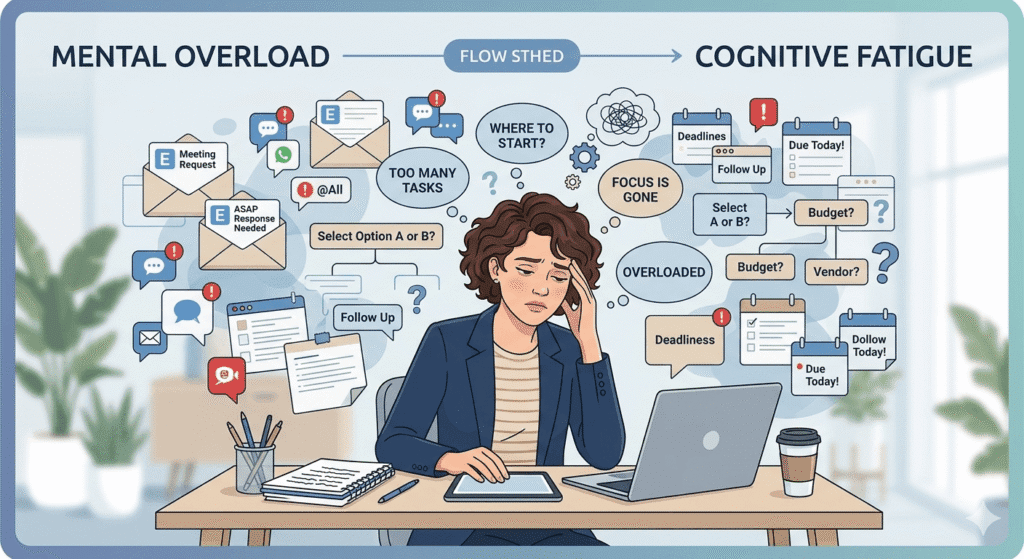
Mental Overload: The Hidden Weight Most People Carry
Mental overload occurs when the number of thoughts, concerns, decisions, and responsibilities competing for attention exceeds the mind’s capacity to process them comfortably.
For professionals, common sources include:
Workplace Demands
- Deadlines
- Meetings
- Performance expectations
- Constant communication
- Information overload
Personal Responsibilities
- Family commitments
- Financial planning
- Health concerns
- Relationship challenges
Internal Pressures
- Fear of failure
- Perfectionism
- Self-doubt
- Unresolved emotional experiences
The mind rarely processes these separately.
Instead, they accumulate.
A simple task then arrives in an already crowded mental space.
How Overthinking Makes Small Tasks Feel Bigger
Overthinking often disguises itself as productivity.
The mind repeatedly analyzes a situation, searching for the perfect solution.
For example:
A simple email becomes:
“What if they misunderstand me?”
“What if I should explain more?”
“What if I send it later?”
The original task remains small.
The mental story surrounding it grows larger.
This is one reason many people feel exhausted without accomplishing much.
Mental activity is not always productive activity.
Awareness helps us notice when thinking has become repetitive rather than useful.
The Connection Between Decision Fatigue and Mental Exhaustion
Every day, people make hundreds of decisions.
Some are obvious.
Others require emotional and mental effort.
Examples include:
- Prioritizing work tasks
- Managing schedules
- Responding to messages
- Financial decisions
- Family decisions
Each decision consumes cognitive resources.
This process is known as decision fatigue.
As mental energy decreases, the brain naturally seeks to conserve resources.
Simple tasks that require additional effort begin to feel more demanding.
The task itself has not changed.
Your available mental energy has.
Signs You May Be Experiencing Mental Clutter
Mental clutter is not always obvious.
Common indicators include:
- Difficulty concentrating
- Procrastinating simple tasks
- Constant mental noise
- Feeling busy but unproductive
- Frequently switching between tasks
- Trouble relaxing
- Difficulty sleeping despite physical tiredness
- Feeling overwhelmed by minor responsibilities
Many professionals normalize these experiences.
Yet they often signal a need for greater awareness and mental space.
Mental Exhaustion vs Physical Tiredness
People often use the terms interchangeably.
They are not the same.
Physical Tiredness
Physical fatigue results from exertion, activity, or lack of rest.
Recovery typically occurs through sleep and physical relaxation.
Mental Exhaustion
Mental exhaustion results from:
- Continuous decision-making
- Emotional strain
- Excessive information processing
- Persistent overthinking
Sleep helps.
But it may not fully restore clarity.
This explains why some people wake up feeling mentally drained despite adequate rest.
The body has recovered.
The mind continues carrying unresolved mental weight.
Why Awareness Is More Helpful Than Motivation
When tasks feel heavy, many people search for motivation.
Motivation can help temporarily.
Awareness creates lasting change.
Awareness allows us to ask:
What am I carrying mentally?
What is demanding my attention right now?
Which concerns require action?
Which concerns are simply occupying space?
Without awareness, we may continue adding new tasks while ignoring the mental clutter already present.
Clarity often emerges when unnecessary mental weight is identified and released.
A Practical Reflection Exercise
Try this simple exercise.
Step 1: Brain Dump
Write down everything currently occupying your attention.
Work responsibilities.
Personal concerns.
Future worries.
Unfinished decisions.
Everything.
Step 2: Categorize
Separate items into:
- Requires action
- Requires planning
- Requires acceptance
Step 3: Observe
Notice how many thoughts are simply repeating themselves without creating progress.
Awareness alone can reduce mental pressure.
Often, the mind feels lighter when thoughts become visible rather than remaining unexamined.
Founder Insight
Through years of observing professionals, entrepreneurs, and individuals navigating personal growth, one pattern appears repeatedly.
People rarely struggle with the task itself.
They struggle with the mental load they bring to the task.
An email feels difficult.
A conversation feels exhausting.
A decision feels overwhelming.
Not because these actions are inherently difficult.
But because the mind has become crowded.
Clarity does not always come from doing more.
Sometimes it comes from creating space.
Awareness is often the beginning of that space.
How to Create More Mental Space
Mental clarity is not achieved through perfection.
It develops through intentional practices.
Consider:
Reflection
Spend five minutes each day observing your thoughts without trying to solve them immediately.
Journaling
Externalizing thoughts reduces mental clutter.
Digital Boundaries
Reduce unnecessary notifications.
Decision Simplification
Limit avoidable decisions where possible.
Meditation
Developing awareness helps create distance between thoughts and reactions.
Conscious Pauses
Allow moments of stillness during the day rather than continuously consuming information.
Small shifts create significant changes over time.
Final Reflection
The next time a small task feels unusually heavy, pause before assuming the task is the problem.
Ask yourself:
“What else am I carrying right now?”
Often, the answer reveals something important.
The task may not be heavy.
The mind carrying it may already be carrying too much.
Mental clarity begins when awareness replaces automatic mental activity.
And awareness begins with noticing.
FAQs
Q: Why do small tasks feel overwhelming?
Small tasks often feel overwhelming because mental overload reduces available cognitive energy. Overthinking, emotional stress, and decision fatigue make simple tasks appear larger than they are.
Q: What causes mental overload?
Mental overload can result from excessive responsibilities, constant information consumption, unresolved concerns, and prolonged stress.
Q: Is procrastination related to mental exhaustion?
Yes. Mental exhaustion often reduces focus and decision-making capacity, making it more difficult to start even simple tasks.
Q: How can I improve mental clarity?
Reflection, awareness practices, journaling, meditation, reducing distractions, and simplifying decisions can improve mental clarity.
Q: Can meditation reduce mental clutter?
Meditation helps develop awareness of thoughts and reduces automatic mental activity, which may support greater clarity and focus.