

Why Can’t I Start My Work Even When I Know What to Do?
The Hidden Psychology of Mental Resistance, Overthinking, and Decision Fatigue
By Ranu Patel | Last Updated: July 5, 2026 | ~6 min read
Knowing what to do but struggling to start is often linked to mental resistance rather than laziness. Decision fatigue, mental overload, emotional avoidance, and constant overthinking can reduce mental energy, making even simple tasks feel difficult to begin.
Have you ever opened your laptop, looked at an important task, and then checked your email, opened social media, made another cup of coffee, organized your desk, or read another article?
Hours later, the task is still waiting. This experience is surprisingly common among professionals, entrepreneurs, managers, students, and business owners. The frustrating part is that you already know what needs to be done.
The challenge isn’t a lack of knowledge, discipline, or an indication that you’re lazy. Often, something much deeper is happening: your mind is experiencing mental resistance. Understanding this invisible barrier can change the way you approach productivity, work, and yourself.
The Myth of Laziness
One of the most damaging beliefs people carry is: “If I can’t start, I must be lazy.” This conclusion creates guilt, which creates pressure, leading to more resistance—and the vicious cycle continues.
- Real laziness usually feels comfortable; mental resistance feels intensely frustrating.
- If you’ve ever wanted to start something but felt emotionally exhausted before even beginning, you’re probably not avoiding work—you’re responding to an overloaded mind.
- Motivation isn’t always the answer. Internal awareness often is.
What Is Mental Resistance?
Mental resistance is the invisible friction between intention and action. You genuinely want to complete the task and understand its importance, yet something inside keeps delaying the first step. It routinely disguises itself as reasonable thoughts:
“I’ll start right after lunch.”
“I need to research just a little more.”
“I’m not in the right mood today; tomorrow will be better.”
When these thoughts repeat consistently, they indicate that your mind is protecting itself from perceived effort, uncertainty, or emotional discomfort. The task itself may not be difficult, but what your mind associates with the task is.
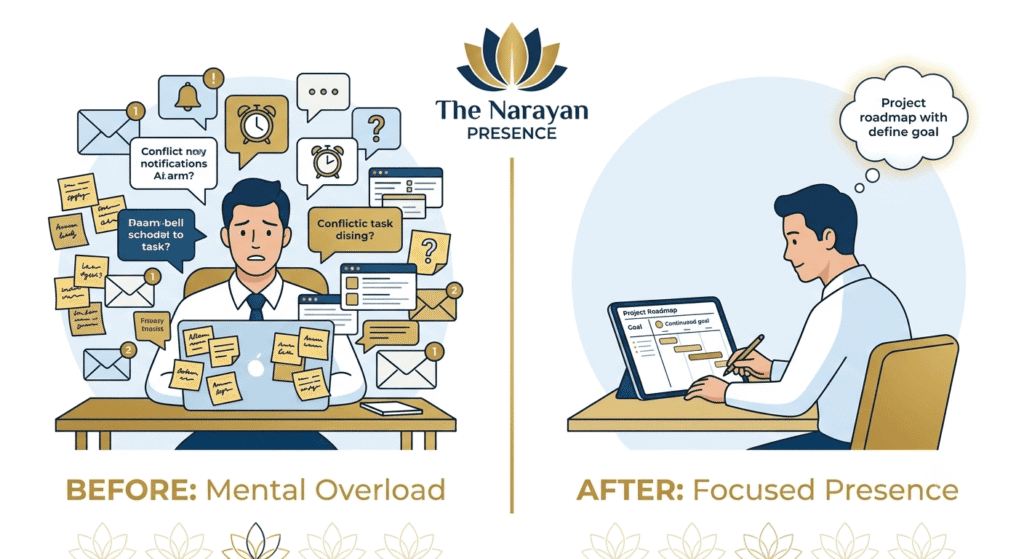
The Four Hidden Reasons You Can’t Start
| 1. Mental Overload | 2. Fear Disguised as Perfectionism |
| Unfinished conversations, future worries, and daily tasks quietly occupy mental attention. When your shelf is full, the mind stops saying “I can’t think” and defaults to “I’ll do it later.” | Procrastination is often emotional avoidance. Questions like “What if it isn’t good enough?” loop silently, causing the brain to postpone the task for internal emotional protection. |
| 3. Constant Digital Stimulation | 4. Emotional Exhaustion |
| Every notification fragments your attention. Switching between tasks increases cognitive load, meaning deep work requires significantly more mental effort, leaving you exhausted despite “working” all day. | Not every burden appears on a calendar. Personal disappointments, relationship tensions, and career uncertainties quietly consume core energetic resources. |
Why Today’s Professionals Experience This More Than Ever
Today’s professionals suffer heavily from decision fatigue. Meetings, deadlines, notifications, emails, and family commitments demand constant calculation. Every small choice consumes mental energy. By the time an important task appears, your available mental energy is depleted—not because the work changed, but because your capacity did.
Why Motivation Isn’t the Real Solution
While motivation can provide a temporary boost, it naturally rises and falls based on emotions, environment, and sleep quality. Relying entirely on feeling motivated makes your progress unpredictable.
What creates sustainable change is awareness. Instead of asking “How do I motivate myself?”, try asking: What is making this task feel difficult? What thought keeps pulling my attention away? What emotion am I avoiding? These shifts move you from self-criticism to self-understanding.
The Narayan Presence Awareness Framework
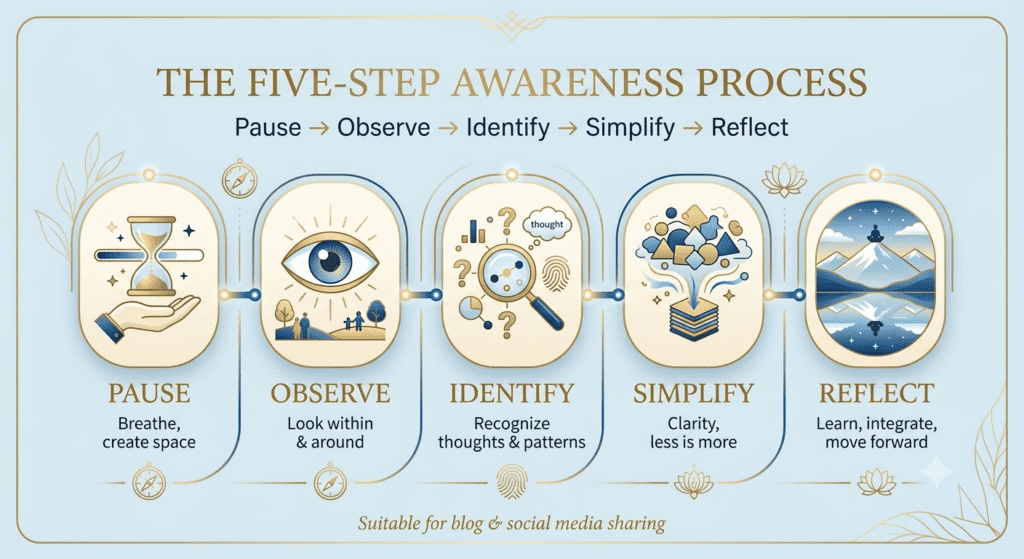
At The Narayan Presence, we believe lasting transformation doesn’t begin by forcing yourself to do more. It begins by understanding your inner experience. Use this five-step awareness framework to ground your mind:
- Step 1: Pause — Before opening another app or blaming yourself, pause for one minute. Give your mind permission to stop reacting.
- Step 2: Observe — Notice what is happening internally. Are you anxious? Overthinking? Simply observing your mental state reduces its overall intensity.
- Step 3: Identify — Ask: “What is the real challenge here?” Is it the task, or is it the fear, uncertainty, or clutter surrounding it?
- Step 4: Simplify — Break the task into the smallest possible next step. Not the entire project—just the next single meaningful action.
- Step 5: Reflect — Spend five minutes at the end of the day evaluating what drained your energy, what kept you present, and what you learned about yourself.
A Practical Reflection Exercise
If you’re feeling mentally stuck today, draw three columns in a notebook and complete this simple processing clearing exercise:
| Column 1: What Is On My Mind? | Column 2: Can I Act On It Today? | Column 3: What Is My Next Small Step? |
|---|---|---|
| Write down every thought without editing (e.g., project deadline, family responsibilities, financial planning). | Mark each item clearly as: Yes, No, or Not now. This separates action from unnecessary loops. | Write only one microscopic action. Instead of “Finish report,” write “Open file and write first paragraph.” |
Founder Insight
“Over the years working with professionals, entrepreneurs, and business owners, I’ve noticed a recurring pattern. Most people don’t struggle because they lack intelligence or ambition; they struggle because they rarely pause long enough to understand what is happening within their own minds. Real transformation rarely begins with dramatic action. It often begins with a quiet moment of honest observation.”
Why This Matters for Professionals in Ahmedabad and Across India
Professionals across Ahmedabad, Gujarat, and other rapidly scaling economic hubs are navigating increasingly intense work environments. Hybrid schedules, rapid tech growth, startup culture, and constant availability create profound mental overload.
Developing mental clarity isn’t about escaping responsibility—it’s about approaching daily accountability with a calmer, more conscious mind.
When to Seek Guidance
If you consistently experience persistent overthinking, difficulty starting vital tasks, chronic mental exhaustion despite resting, or a feeling of being emotionally overwhelmed, it may be helpful to explore structured reflection, mindfulness, or awareness-based coaching.
- Difficulty starting important work or constant procrastination
- Persistent overthinking and trouble focusing
- Mental exhaustion despite adequate rest
Frequently Asked Questions
- Why can’t I start my work even when I know what to do?
Because mental resistance, decision fatigue, overthinking, and emotional exhaustion can make simple tasks feel overwhelming, even when you understand exactly what needs to be done. - Is this laziness or something else?
Not always. Many people experience mental overload rather than laziness. Understanding the difference can help you respond with awareness instead of self-criticism. - What is mental resistance?
Mental resistance is the inner friction between intention and action. It often appears as procrastination, avoidance, or difficulty beginning important tasks. - Can overthinking stop me from taking action?
Yes. Repeated analysis can consume mental energy and delay action, making simple tasks feel more complex than they actually are. - How can I improve mental clarity?
Reflection, mindfulness, journaling, reducing unnecessary digital distractions, and awareness-based practices can help create greater mental clarity over time.
Ready to transcend mental fatigue and build a conscious approach to work?
Stop fighting against your own mind with unsustainable productivity hacks. Connect with The Narayan Presence today to step into authentic clarity.
About the Author
Ranu Patel is the founder of The Narayan Presence, bringing over 16 years of corporate expertise within the IT industry. Drawing from deep personal execution and awareness-based frameworks, Ranu helps professionals, entrepreneurs, and business leaders cultivate sustainable mental clarity, conscious choice architectures, and deep personal transformation through integrated reflection, applied mindfulness, NLP, meditation, and Reiki.