
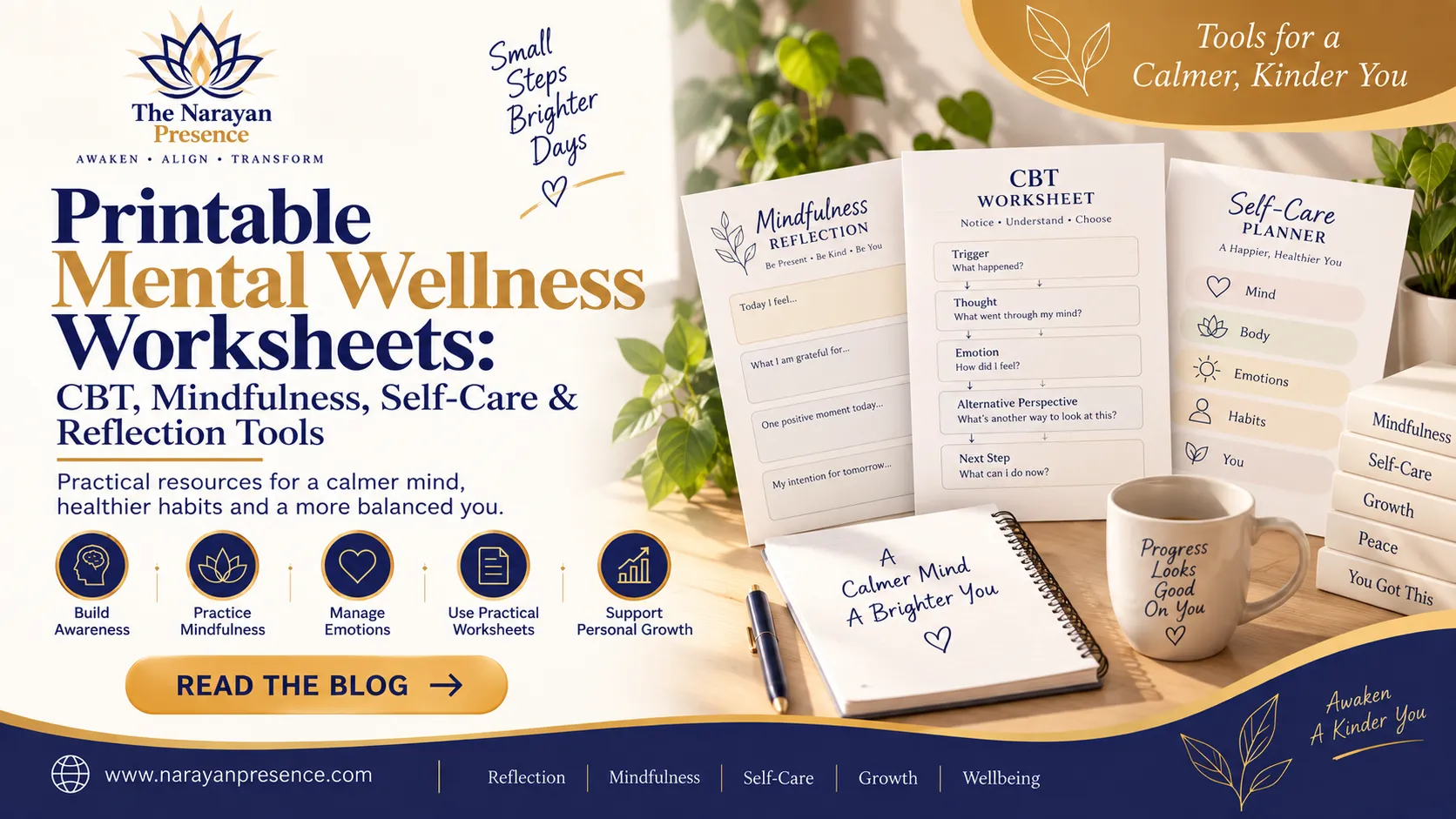
Printable Mental Wellness Worksheets: CBT, Mindfulness, Self-Care & Reflection Tools
There is a difference between reading about your mental wellbeing and actually working with it. Articles and videos hand you information, but information alone rarely changes a pattern. What tends to move the needle is doing something with it — noticing, reflecting, writing, practising, and reviewing. That is exactly what a good worksheet is for.
Printable mental wellness worksheets give structure to that process. Instead of a blank page and a vague intention to “work on yourself,” you get clear prompts that walk you from a busy thought to a steadier place. This guide covers the main types — CBT, mindfulness, anxiety and overthinking, self-care, emotional regulation, and ACT values worksheets — how each one helps, and how to build them into a simple personal toolkit. It is just as relevant if you are a coach, counsellor, or wellness practitioner looking for structured reflection resources for clients.
What Are Mental Wellness Worksheets?
Mental wellness worksheets are printable (or digital) reflection sheets that turn a wellbeing concept into something you can practise. Rather than passively absorbing an idea, you follow a simple cycle:
They come in several families, each aimed at a different part of emotional life — and they work best in combination, which is why bundled toolkits tend to be more useful than a single sheet.
There is also a simple reason writing helps: putting a thought on paper moves it out of the fast, looping part of the mind and into a slower, more deliberate one. You can look at a written thought, question it, and notice patterns across days and weeks that are invisible when everything stays in your head. That is why the same worksheet, revisited over time, often reveals more than any single session of thinking ever could.
CBT Worksheets
Cognitive Behavioural Therapy–inspired worksheets focus on the link between thoughts, feelings, and behaviour. They help you catch automatic negative thoughts, spot the cognitive distortions (thinking traps) that distort them, and reframe them into something more balanced. A typical CBT worksheet traces a thought from trigger to response and then asks you to weigh the evidence for and against it.
Over time this builds a genuinely different relationship with your own thinking. Tools like the S.P.O.T. method for catching thoughts, a guide to the 11 most common distortions, a reframing worksheet, and a productive-versus-unproductive-worry flowchart are the backbone of this family — the point is not to argue every thought into submission, but to create enough space between a thought and your reaction that you can choose how to respond.
Mindfulness Worksheets
Mindfulness worksheets bring attention back to the present. Prompts around present-moment awareness, grounding, body awareness, gratitude, and reflection help interrupt the mental time-travel between past regret and future worry. They are gentle, low-effort, and especially helpful when your mind is racing and a longer exercise feels like too much. Pairing a short written prompt with a guided meditation makes the practice even easier to stick with — you read, settle, and then let the audio carry you the rest of the way.
Anxiety & Overthinking Worksheets
Anxiety and overthinking worksheets tackle the worry cycle head-on: “what if” thinking, decision paralysis, catastrophizing, and difficulty switching off. Useful tools here include a worry cycle map, trigger identification, a worry window, and a calm plan. The aim is not to eliminate worry but to contain it — to give it a boundary instead of letting it run the whole day.
Self-Care Worksheets
Self-care worksheets move self-care from a vague idea to a set of small, trackable habits. Think emotional check-ins, weekly reflection, energy tracking, boundaries, and rest. A habit tracker keeps the intention visible, and a weekly reflection page helps you notice what actually restores you rather than what you assume should.
Emotional Regulation Worksheets
Emotional regulation worksheets help you respond rather than react. They often map the chain of Trigger → Thought → Feeling → Response, then introduce a pause: Pause → Notice → Choose. Seeing your own pattern on paper creates just enough space to choose a different response next time — which is the whole skill.
ACT & Values-Based Reflection Worksheets
Acceptance and Commitment Therapy–inspired worksheets add a powerful ingredient: values. Instead of only managing difficult thoughts, they ask what kind of life you want to move toward. A Values Compass across work, relationships, growth, and leisure helps you take meaningful action even when uncomfortable feelings are present. This is a great differentiator, because it turns reflection into direction.
Self-Compassion Worksheets
Self-compassion worksheets are the quiet counterweight to a harsh inner critic. They guide you to speak to yourself the way you would to a friend — acknowledging a struggle, recognising that difficulty is part of being human, and offering yourself a kinder response. For people whose overthinking is fuelled by perfectionism, self-compassion tools are often the piece that finally lowers the pressure.
Worksheets for Coaches, Counsellors & Wellness Practitioners
These same tools are widely used beyond personal practice. Coaches, counsellors, and wellness practitioners often use structured reflection resources to facilitate conversations, set client homework, and support between-session reflection — always within their own scope of practice. Printable worksheets are easy to share digitally or hand out in person, which makes them a practical addition to a professional toolkit.
How to Actually Use Worksheets (So They Work)
A worksheet only helps if you use it, so keep the bar low. Pick one sheet, not ten. Set aside five quiet minutes rather than waiting for a free hour that never comes. Write honestly, since no one else needs to read it. And treat it as a practice, not a test — there is no wrong answer, only noticing.
Many people find a rhythm that works: a quick daily check-in, a slightly longer weekly reflection, and a specific tool (like a reframing or grounding sheet) kept on hand for harder moments. Consistency matters far more than intensity; a few minutes most days will do more than an occasional marathon session.
How to Build a Personal Mental Wellness Toolkit
You do not need dozens of worksheets — you need a small, complementary set you will actually use. A well-rounded toolkit looks like this:
- A thought / reframing worksheet (CBT)
- An emotion check-in (emotional regulation)
- A grounding exercise (mindfulness)
- A self-care habit tracker
- A values exercise (ACT)
- A weekly reflection page
- A guided meditation for wind-down
That set maps almost exactly onto the Mindful Mind & Overthinking Reset Bundle from Narayan Presence, which combines the CBT + ACT Workbook and the Quiet the Overthinking Mind guide into one 30-page printable toolkit and adds a 30-minute guided meditation in Hindi and English. It follows a complete Notice → Understand → Reflect → Reset → Move Forward journey — CBT reframing, a worry window, an ACT Values Compass, an overthinking cycle, a R.E.S.E.T. framework, a self-care habit tracker, and a personal calm plan, all in one place. Print the pages you want, keep the rest on a screen, and return to your favourites whenever a familiar pattern shows up.
Printable vs Digital Worksheets
Printable worksheets are tangible, easy to write on, and satisfying to keep in a folder you can return to. Digital versions are portable, reusable, and simple to complete on a phone or tablet. Because the Narayan Presence resources are delivered as PDFs that work both ways, you can print the pages you want and keep the rest on a screen — and reuse either format whenever a familiar pattern shows up.
Mindful Mind & Overthinking Reset Bundle
Get the complete 30-page printable toolkit featuring CBT + ACT reframing tools, worry windows, calm plans, habit trackers, and a 30-minute guided meditation audio.
When to Seek Professional Support
These worksheets are made for general education, self-reflection, and self-care. They are not medical advice, diagnosis, therapy, or treatment, and they are not a substitute for care from a qualified professional. If you are experiencing significant or persistent distress, please reach out to an appropriately qualified healthcare or mental health professional — structured self-care works best alongside that support, not instead of it.
Frequently Asked Questions
What are mental health worksheets?
They are structured reflection sheets that turn wellbeing concepts — like managing thoughts, emotions, worry, or self-care — into practical exercises you can complete and return to.
What are CBT worksheets used for?
CBT worksheets help you notice automatic thoughts, identify thinking traps, and reframe them, so unhelpful thought patterns have less pull over how you feel and act.
What are anxiety worksheets?
Anxiety worksheets target the worry cycle — “what if” thinking, catastrophizing, and decision paralysis — with tools like a worry map, trigger identification, a worry window, and a calm plan.
What are mindfulness worksheets?
Mindfulness worksheets use prompts around present-moment awareness, grounding, body awareness, and gratitude to bring your attention out of past regret or future worry and back to the present.
What is the difference between CBT and ACT worksheets?
CBT worksheets focus on noticing and reframing unhelpful thoughts, while ACT worksheets focus on clarifying your values and taking meaningful action even when difficult thoughts or feelings are present. They complement each other well, which is why many toolkits include both.
Can coaches use mental health worksheets?
Yes — within their scope of practice, coaches and wellness practitioners often use these as structured reflection prompts and client homework rather than as clinical treatment.
Are printable worksheets useful?
Very. Writing by hand slows thinking down and aids reflection, and printable PDFs are reusable, so you can return to the exercises whenever a familiar pattern returns.