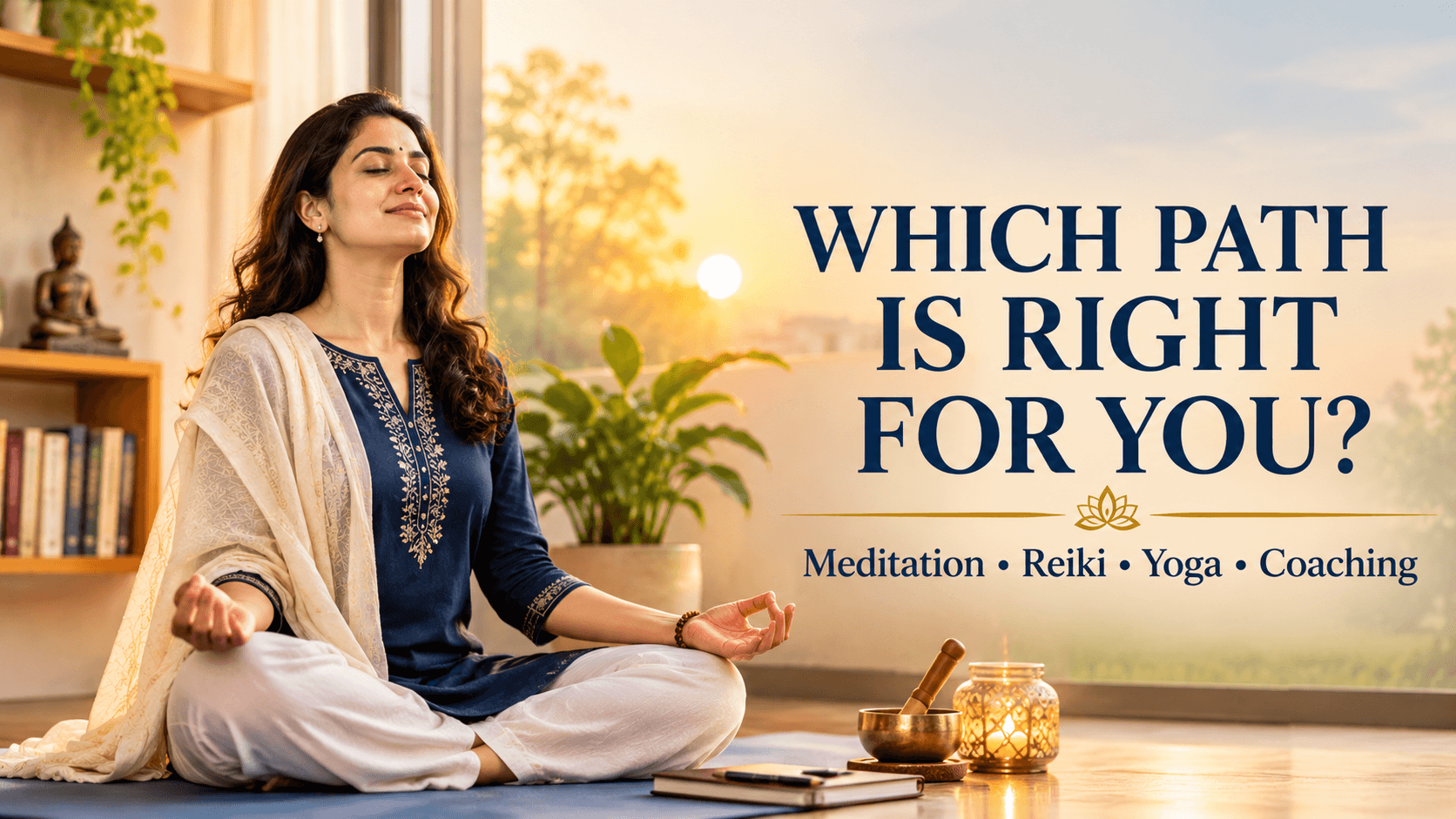
Which Practice Is Right for You?
Meditation, Reiki, yoga, Vipassana, and life coaching are not competing practices—each supports awareness, wellbeing, and personal growth in a different way. The right choice depends on what you are experiencing, what you wish to explore, and what kind of support you are looking for right now.
Introduction
By The Narayan Presence | Last Updated: November 2026 | ~14 min read
Some turn towards meditation. Others explore yoga, Reiki, Vipassana, spiritual healing, mindfulness, or life coaching. But with so many approaches available, a common question arises:
Which practice is right for me?
Should you meditate every day? Is yoga enough to calm the mind? Can Reiki support your inner journey? Is Vipassana different from meditation? Or would life coaching help you understand your thoughts, emotions, decisions, and life direction better?
The truth is that these practices are not necessarily competing with each other. Each offers a different approach to awareness, self-understanding, wellbeing, and personal development.
The right practice depends on what you are experiencing, what you wish to explore, and what kind of support you are looking for.
At The Narayan Presence, we believe transformation begins when you start understanding yourself—not when you blindly follow another person’s path.
Find Your Presence. Transform Your Life.
Why Are So Many People Searching for Inner Peace?
Life today moves quickly. We are constantly exposed to information, expectations, responsibilities, comparison, and pressure to perform.
A person may be professionally successful but emotionally exhausted. Someone may have a loving family but still feel disconnected from themselves. Another person may be doing everything right on the outside while experiencing overthinking, uncertainty, stress, or a lack of clarity internally.
People often begin searching for different practices because they want to:
- Stop overthinking and experience mental clarity
- Manage everyday stress and emotional overwhelm
- Improve their relationships
- Develop self-awareness
- Build confidence and make better decisions
- Find purpose and direction
- Feel more connected with themselves
- Develop a deeper spiritual understanding
- Create healthier habits and a more peaceful lifestyle
There is no single method that works identically for everyone.
Sometimes, the first step is simply learning how to pause.
Sometimes, it is learning how to observe your thoughts without believing every thought.
Sometimes, you need movement, breathing, reflection, guidance, or a structured conversation that helps you understand what is happening in your life.
Let’s explore these practices individually.
1. What Is Meditation?
Meditation is a practice of developing awareness, attention, and a more conscious relationship with your thoughts, feelings, sensations, and present-moment experiences.
Many people believe meditation means stopping the mind completely.
But that is not necessarily the goal.
Your mind may continue producing thoughts. You may remember something from the past, think about tomorrow’s responsibilities, or become distracted by sounds around you.
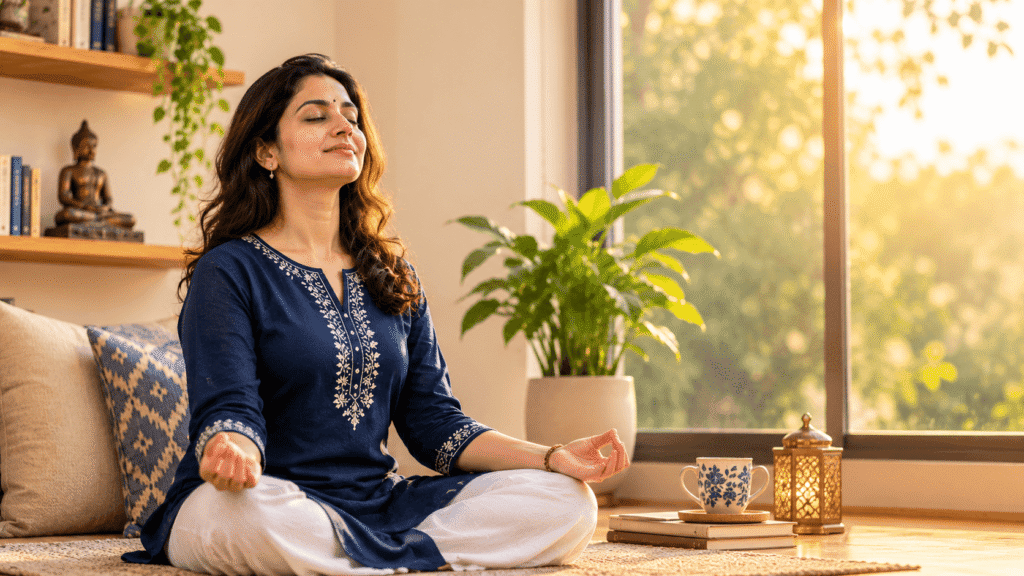
Meditation is the practice of noticing these experiences without constantly getting pulled into them.
How meditation can help
A consistent meditation practice may support:
- Greater awareness of thoughts and emotions
- Better attention and concentration
- A sense of calm and relaxation
- More conscious responses instead of automatic reactions
- Better understanding of mental patterns
- A deeper connection with the present moment
Different types of meditation
Meditation is not one single technique.
Some common approaches include:
- Breath awareness meditation: Observing your natural breathing without trying to control it.
- Guided meditation: Following verbal instructions that guide your attention through relaxation, awareness, visualisation, or reflection.
- Mindfulness meditation: Bringing attention to the present experience with openness and curiosity.
- Loving-kindness meditation: Cultivating feelings of kindness, compassion, and goodwill towards yourself and others.
- Mantra meditation: Repeating a mantra or sound as a focus for attention.
Who may benefit from meditation?
Meditation may be helpful for someone who:
- Feels mentally distracted
- Wants to become more self-aware
- Is interested in mindfulness
- Wants to develop a daily inner practice
- Finds themselves constantly thinking about the past or future
- Wants to create space between a thought and a reaction
A simple meditation practice for beginners
You don’t need to sit for an hour to begin.
Try this simple five-minute practice:
- Sit comfortably.
- Close your eyes, if comfortable.
- Notice your natural breathing.
- Observe thoughts as they arise.
- When your mind wanders, gently bring your attention back to your breath.
- Don’t judge yourself for getting distracted.
The moment you notice that your mind has wandered is also a moment of awareness.
You don’t need to fight your thoughts. You can learn to observe them.
2. What Is Reiki?
Reiki is a complementary spiritual and wellness practice that originated in Japan.
The word Reiki is commonly associated with the concepts of universal life energy. Reiki practitioners use a traditional approach involving gentle hand placement on or near the body, with the intention of supporting relaxation and wellbeing.
Many people explore Reiki because they are looking for a peaceful experience, spiritual connection, relaxation, or an opportunity to pause from their everyday stress.
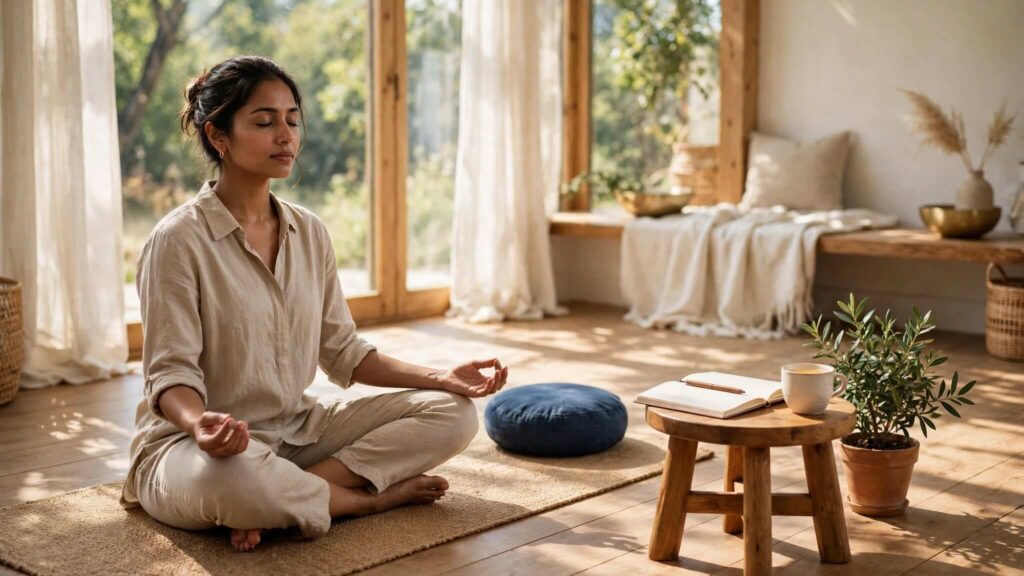
What happens during a Reiki session?
A Reiki session is generally conducted in a quiet, comfortable environment.
Depending on the practitioner and the session format, the experience may include:
- Relaxation
- Gentle hand placement or hands held above the body
- Quiet time
- Guided breathing
- Meditation
- A peaceful environment
Some individuals describe feeling warmth, calmness, relaxation, or emotional release during a session. Experiences differ from person to person.
Why do people explore Reiki?
People may explore Reiki as a complementary practice for:
- Relaxation
- Spiritual exploration
- Creating time for themselves
- Supporting a personal wellness routine
- Developing a sense of peace
- Exploring mind-body awareness
It is important to understand that Reiki is a complementary practice. Scientific evidence for specific medical benefits remains limited, and Reiki should not replace medical care, psychological treatment, or prescribed medication.
Is Reiki suitable for everyone?
People may have different experiences and beliefs about Reiki.
If you are curious about it, approach it with an open mind but also with healthy discernment. A responsible practitioner should respect your boundaries, never promise miraculous outcomes, and never encourage you to discontinue medical treatment.
3. What Is Yoga?
Yoga is much more than physical exercise.
Although many people begin yoga because they want flexibility, strength, mobility, or fitness, traditional yoga encompasses a broader journey involving the body, breath, mind, awareness, and discipline.
Yoga practices may include:
- Physical postures (asanas)
- Breathing practices (pranayama)
- Meditation
- Concentration
- Relaxation
- Self-discipline
- Mindful awareness
How yoga may support wellbeing
Regular yoga practice may help people develop:
- Greater body awareness
- Flexibility and mobility
- Physical strength and balance
- Mindful breathing
- Relaxation
- A connection between body and mind
Yoga also creates an opportunity to slow down and become more aware of what is happening within you.
For example, while practising a posture, you may notice that you are holding your breath, feeling impatient, pushing yourself beyond your limits, or comparing your performance with others.
That awareness can become an important part of personal growth.
Yoga is not about perfection
You don’t need to be flexible to begin yoga.
You don’t need to perform advanced postures.
You don’t need to look like someone you see on social media.
Yoga can begin with a simple stretch, conscious breathing, and learning to listen to your body.
The purpose of your practice should be to develop a healthier relationship with yourself—not to compete.
Who may benefit from yoga?
Yoga may be suitable for people who:
- Want to improve physical wellbeing
- Feel physically tense
- Want to combine movement and mindfulness
- Prefer an active approach to relaxation
- Want to develop breathing awareness
- Are looking for a regular wellness routine
Choose practices appropriate for your physical condition and consult a qualified healthcare professional when necessary, particularly if you have injuries or health concerns.
4. What Is Vipassana Meditation?
Vipassana is a traditional meditation practice commonly described as insight meditation.
The word Vipassana is often understood as seeing things clearly or observing reality as it is.
Rather than trying to escape thoughts, sensations, or emotions, the practitioner develops the ability to observe experiences with awareness and without immediately reacting.
In Vipassana practice, attention may be directed towards:
- Breathing
- Physical sensations
- Thoughts
- Emotions
- The changing nature of experiences
A central aspect of the practice is learning to observe without constantly craving, resisting, judging, or reacting.
How is Vipassana different from general meditation?
Meditation is a broad term that includes many techniques.
Vipassana is a particular approach to meditation focused on developing insight through observation and awareness.
For example:
| Meditation | Vipassana |
|---|---|
| A broad category of practices | A specific insight-oriented meditation approach |
| May use breath, mantra, visualisation or guided instructions | Emphasises observation and awareness |
| Practices can have different goals | Focuses on understanding experience and developing insight |
| Can be short and beginner-friendly | May involve more structured and intensive practice |
Who may be interested in Vipassana?
Vipassana may appeal to people who:
- Want to develop deeper self-awareness
- Are interested in observing their thought patterns
- Want to understand reactions and emotional habits
- Are curious about traditional meditation practices
- Wish to explore mindfulness more deeply
Intensive meditation is not suitable for everyone at every stage. If meditation causes significant distress or worsens psychological symptoms, consider stopping and seeking guidance from a qualified professional.
5. What Is Life Coaching?
Life coaching is a guided process that helps individuals explore their current situation, goals, values, challenges, possibilities, and next steps.
While meditation helps you develop awareness, life coaching often helps you translate awareness into decisions and actions.
Sometimes people know that something in their life needs to change, but they are unsure what to do.

They may be asking themselves:
- What do I really want?
- Why do I keep repeating the same patterns?
- Why am I unable to make a decision?
- How can I improve my relationships?
- Why do I lack confidence?
- What should I do about my career?
- How can I become more consistent?
- How do I balance my personal and professional life?
Life coaching provides a space to explore such questions.
What happens during life coaching?
A coaching conversation may involve:
- Understanding your current situation
- Identifying goals and priorities
- Exploring beliefs and thought patterns
- Recognising strengths
- Examining challenges
- Developing clarity
- Creating practical action steps
- Reviewing progress
The purpose is not for someone else to control your life or tell you exactly what you must do.
Good coaching helps you become more conscious of your own choices.
Who may benefit from life coaching?
Life coaching may be helpful for individuals who:
- Feel stuck in life
- Want more clarity about their future
- Are navigating career or business decisions
- Want to improve communication
- Want to develop confidence
- Are working towards personal goals
- Want to improve their relationships
- Are looking for personal growth and accountability
Life coaching is not psychotherapy and is not intended to diagnose or treat mental health conditions.
6. What Is Healing or Personal Growth Coaching?
Many people use the word healing to describe their journey towards greater self-understanding, emotional awareness, inner peace, and personal growth.
A personal growth or healing-oriented coaching approach may help you explore your experiences, patterns, beliefs, emotional responses, and relationship with yourself.
The word healing can mean different things to different people.
For some, it means learning to let go of resentment. For others, it means recognising emotional triggers, changing unhealthy patterns, rebuilding confidence, reconnecting with their values, or creating healthier boundaries.
What might a personal growth session explore?
Depending on the approach, conversations may include:
- Self-awareness
- Emotional patterns
- Overthinking
- Personal boundaries
- Relationship patterns
- Confidence
- Self-worth
- Life direction
- Stress management habits
- Mindfulness
- Reflection and journaling
The focus is on helping you understand yourself better and make more conscious choices.
It is important to distinguish personal growth coaching from mental-health treatment. Trauma, severe anxiety, depression, or other psychological concerns may require support from a qualified mental-health professional. A responsible coach or wellness practitioner should recognise those boundaries.
7. Meditation vs Reiki vs Yoga vs Vipassana vs Life Coaching
So, which practice should you choose?
The answer depends on what you want to explore.
| If you are looking for… | You may explore… |
|---|---|
| Greater awareness of thoughts | Meditation |
| Mindfulness and present-moment awareness | Mindfulness meditation |
| Physical movement and flexibility | Yoga |
| Breath and body awareness | Yoga and breathing practices |
| Deeper observation of sensations | Vipassana |
| Spiritual or complementary wellness experience | Reiki |
| Clarity about goals and decisions | Life coaching |
| Understanding personal patterns | Personal growth coaching |
| A structured path of reflection and insight | Vipassana or guided meditation |
| Daily self-reflection | Journaling and reflective reading |
| Better understanding of yourself | Meditation, coaching and journaling |
You do not have to choose only one.
Sometimes, the combination of practices can be more meaningful than following one approach exclusively.
For example:
- Yoga may help you connect with your body.
- Meditation may help you observe your mind.
- Journaling may help you understand your experiences.
- Coaching may help you turn insight into practical action.
- Reiki may provide a complementary spiritual or relaxation experience.
Your journey can be flexible.
8. Why Understanding Yourself Is More Important Than Following a Trend
One of the biggest mistakes people make is trying every new practice without understanding why they are doing it.
They may attend meditation sessions, download wellness apps, watch motivational videos, try different healing practices, and read countless self-help books.
Yet they may still feel confused.
Why?
Because collecting practices is not the same as developing self-awareness.
The real question is:
What am I trying to understand or change within myself?
Are you constantly overthinking?
Are you struggling with communication?
Are you emotionally reacting to situations?
Are you avoiding difficult decisions?
Are you trying to find a purpose?
Are you feeling disconnected from your own needs?
When you understand the real challenge, you can choose a practice with greater clarity.
You don’t need to do everything.
You need to begin with what is meaningful for you.
9. A Simple 10-Minute Practice to Begin Your Inner Journey
You don’t need an expensive programme, complicated technique, or perfect environment to begin developing self-awareness. Try this simple daily practice.
Minute 1–2: Pause
Sit comfortably.
Put your phone aside.
Allow yourself to pause without trying to achieve anything.
Minute 3–4: Observe your breathing
Notice the natural rhythm of your breath.
Don’t force it.
Simply observe.
Minute 5–6: Observe your thoughts
Notice what is happening in your mind.
Are you thinking about work?
A relationship?
Something that happened yesterday?
Something you fear may happen tomorrow?
Don’t judge the thoughts.
Simply notice them.
Minute 7–8: Observe your emotions
Ask yourself gently:
“What am I feeling right now?”
You may notice anxiety, frustration, sadness, happiness, confusion, gratitude, or nothing particularly clear.
Whatever you notice, allow yourself to acknowledge it.
Minute 9: Ask yourself one meaningful question
Choose one question:
- What do I need today?
- What am I avoiding?
- What is consuming my mental energy?
- What is one thing I can control?
- What would a more conscious response look like?
Minute 10: Choose one small action
Don’t try to transform your entire life in one day.
Choose one small action.
Perhaps you need to have a conversation.
Perhaps you need to rest.
Perhaps you need to set a boundary.
Perhaps you need to complete one important task.
Perhaps you simply need to stop overthinking a decision and take the next step.
Small, conscious actions can gradually become meaningful habits.
10. How to Choose the Right Coach or Healing Practitioner
If you decide to explore life coaching, meditation guidance, Reiki, or any wellness practice, choosing the right practitioner matters. Here are some things to consider.
1. Look for transparency
The practitioner should clearly explain what the service involves, how sessions work, what you can expect, and what the approach can and cannot offer.
2. Avoid unrealistic promises
Be cautious of anyone promising guaranteed results, instant transformation, miracle cures, or complete solutions to every problem. Personal growth is individual. No responsible practitioner can guarantee identical outcomes for everyone.
3. Respect your personal boundaries
You should feel comfortable asking questions and deciding whether a session or programme is appropriate for you. You should never feel pressured to continue.
4. Understand the difference between coaching and therapy
Coaching generally focuses on personal development, goals, awareness, decisions, and action.
Psychotherapy and mental-health treatment address psychological conditions and concerns within the scope of qualified professionals.
If you are experiencing persistent distress, severe anxiety, depression, trauma-related symptoms, or difficulties that significantly affect daily functioning, seek support from a qualified mental-health professional.
5. Choose an approach that resonates with you
You don’t need to follow someone simply because they are popular.
The right approach should align with your needs, beliefs, comfort, goals, and personal circumstances.
11. How The Narayan Presence Supports Your Personal Growth Journey
At The Narayan Presence, our approach is rooted in self-awareness, conscious living, emotional understanding, reflection, and practical transformation.
We believe every individual has the potential to understand themselves more deeply and create a more conscious relationship with their life.
Our work explores different dimensions of personal growth, including:
- Life and personal growth coaching
- Relationship awareness and communication
- Mindfulness and meditation
- Overthinking and thought patterns
- Emotional awareness
- Parenting and family relationships
- Spiritual exploration
- Personal reflection
- Conscious living
- Practical habits for growth
The goal is not to make you dependent on someone else’s guidance.
The goal is to help you reconnect with your own awareness, understand your patterns, and make more conscious choices.
Sometimes, the most meaningful transformation begins with a simple realisation:
You don’t need to change everything around you before you begin changing your relationship with yourself.
You can begin by becoming aware of how you think, how you feel, how you react, and what you choose every day.
12. Books That Can Support Your Journey of Self-Reflection
Reading can also become a powerful companion to meditation, mindfulness, and personal growth.
At The Narayan Presence, we believe a meaningful thought, when understood and applied, can create a small but important shift in the way you see your life.
The Overthinking Cure
If your mind constantly revisits conversations, worries about the future, analyses situations, or struggles to switch off, understanding your thinking patterns can be an important first step.
The Overthinking Cure is created for readers who want to explore their relationship with overthinking and develop a more conscious way of approaching their thoughts.
Instead of believing every thought or fighting your mind, you can begin learning to recognise patterns and respond with greater awareness.
Explore the book:
The Overthinking Cure – Read More
Ek Baat Roz
Personal transformation doesn’t always require a big event.
Sometimes, one meaningful thought each day can help you pause, reflect, and see something differently.
Ek Baat Roz is an invitation to bring meaningful reflection into your daily life.
Read one thought.
Pause.
Reflect.
And ask yourself:
“How can I apply this in my life today?”
The power of reflection lies not only in what you read but in what you consciously practise.
Explore the book:
Ek Baat Roz – Read More
13. You Don’t Need to Follow Every Path
Meditation, Reiki, yoga, Vipassana, life coaching, and personal growth are different approaches.
Each may offer something valuable depending on your individual needs, interests, and circumstances.
You don’t need to compare them.
You don’t need to follow every practice.
You don’t need to become a different person overnight.
You can begin with a single question:
What would help me understand myself better right now?
If you need awareness, begin with meditation.
If you want to connect with your body and breath, explore yoga.
If you want deeper observation, explore Vipassana.
If you are curious about a complementary spiritual practice, explore Reiki responsibly.
If you need clarity about your goals, choices, relationships, or life direction, life coaching may be worth exploring.
And if you simply need a moment to pause, begin there.
Your inner journey doesn’t have to be complicated.
It only needs to begin.
Frequently Asked Questions (FAQs)
1. Which is better: meditation or Reiki?
Meditation and Reiki are different practices. Meditation generally focuses on awareness, attention, and observing thoughts and experiences. Reiki is a complementary spiritual or wellness practice commonly associated with relaxation and energy-based traditions. Neither is universally better. The right choice depends on your personal interests and what you wish to explore.
2. What is the difference between meditation and Vipassana?
Meditation is a broad category of practices involving attention, awareness, concentration, relaxation, or reflection. Vipassana is a particular meditation approach associated with insight and observing experiences, including sensations, thoughts, and emotions, without automatically reacting to them.
3. Can yoga help with stress and overthinking?
Yoga combines physical postures, breathing, and awareness. Many people find yoga helpful as part of a wellbeing routine because it gives them an opportunity to slow down, connect with their body, and practise mindful breathing. It is not a guaranteed treatment for stress-related or mental-health conditions.
4. Can meditation help me stop overthinking?
Meditation may help you become more aware of your thoughts and develop a different relationship with them. The goal is not necessarily to stop thoughts completely. It is to learn to notice thoughts without automatically getting caught in every thought or reacting to it.
5. Is life coaching the same as healing?
Not necessarily. Life coaching generally focuses on awareness, goals, decisions, personal development, and action. The word healing can refer to different experiences, including emotional reflection, spiritual exploration, relaxation, and personal growth. Neither coaching nor complementary healing practices should be confused with medical or psychological treatment.
6. Can I practise meditation and yoga together?
Yes. Many people combine yoga and meditation. Yoga can involve movement, posture, and breathing awareness, while meditation provides an opportunity for stillness and observation. You can adapt your practice to your needs and comfort.
7. Can I combine Reiki with meditation?
Some people choose to combine Reiki and meditation as part of their personal wellness or spiritual routine. The practices have different approaches, and your experience may vary. Choose a qualified and responsible practitioner if you decide to explore Reiki.
8. Which practice is best for beginners?
There is no universally best practice for everyone. A beginner might start with five minutes of breathing awareness, gentle yoga, guided meditation, daily journaling, or a reflective practice. Choose something simple and comfortable that you can practise consistently.
9. How do I find a life coach in Ahmedabad or Gujarat?
Look for a coach whose approach aligns with your needs. Check their experience, services, communication style, transparency, and boundaries. Ask what coaching involves before committing to a programme. You may also explore online coaching if you prefer guidance from the comfort of your home.
10. Can online life coaching be effective?
Online coaching can provide a convenient way to have structured conversations, reflect on goals, and explore personal challenges from your own environment. The experience depends on the coach, the individual, the coaching approach, and your willingness to participate actively.
Final Thoughts: Your Journey Begins With Awareness
You may come to meditation because you want peace.
You may explore yoga because you want to reconnect with your body.
You may be curious about Reiki because you want to explore a spiritual practice.
You may choose Vipassana because you want to understand your mind more deeply.
Or you may seek life coaching because you are ready to make decisions, understand patterns, and move forward.
Whatever path you choose, remember:
The purpose is not to become someone else. It is to become more conscious of who you already are.
Your journey begins with awareness.
Your growth begins with understanding.
And transformation begins when you consciously choose your next step.
At The Narayan Presence, we invite you to explore your inner journey with openness, compassion, and awareness.
Find Your Presence. Transform Your Life.
If you are exploring personal growth, overthinking, relationships, emotional awareness, or life direction and would like guidance, you are welcome to connect with us.
Explore The Narayan Presence
Begin your journey with awareness, clarity, and conscious living.
Important: Life coaching, meditation, Reiki, and personal-growth guidance are not substitutes for medical, psychological, financial or legal advice. Where specialised support is needed, consult an appropriately qualified professional.
The Narayan Presence
Find Your Presence. Transform Your Life.
Ahmedabad, Gujarat, India | Online coaching and personal growth resources for people across India and worldwide.