
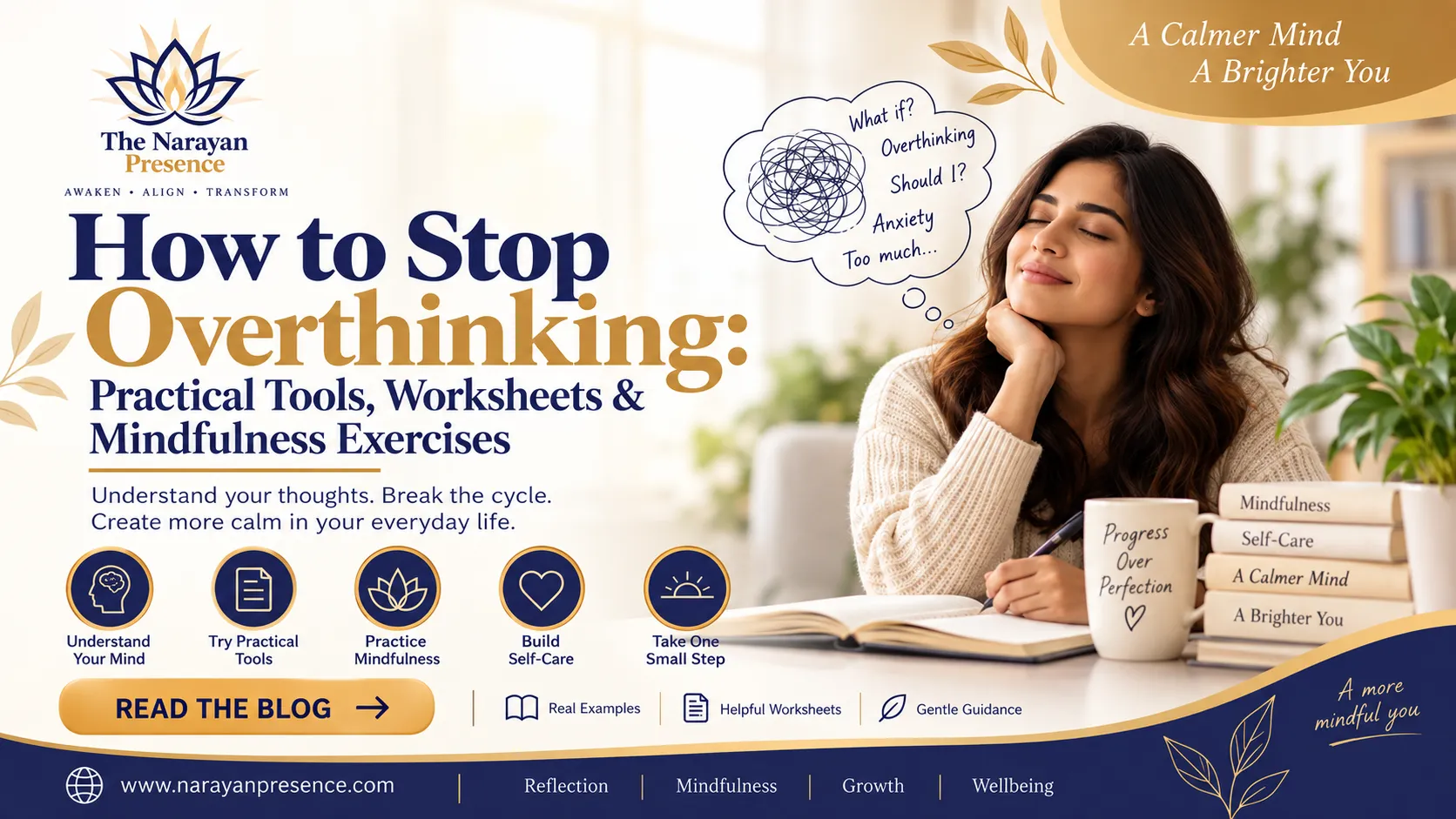
How to Quiet an Overthinking Mind
If your mind replays the same conversation ten times before you fall asleep, or you freeze over a small decision because every option suddenly feels risky, you already know that “just stop thinking about it” is useless advice. Overthinking is not a willpower problem. It is a pattern — a loop the mind falls into when it is trying to protect you from uncertainty, mistakes, or discomfort. And like any pattern, it can be interrupted.
The frustrating part is that telling yourself to relax rarely works, because the effort itself keeps the loop spinning. What tends to help far more is structured reflection: getting the thought out of your head, understanding what is driving it, and choosing one small, deliberate response. This guide covers what overthinking really is, why the mind keeps doing it, and eight practical exercises, worksheets, and mindfulness techniques you can reach for the next time your thoughts will not settle.
What Is Overthinking?
Overthinking is repetitive, circular thinking that feels productive but rarely leads anywhere useful. There is a meaningful difference between reflection — thinking that moves you toward understanding or a decision — and rumination, which loops over the same ground without resolution. Most people who describe themselves as overthinkers are stuck in the second one.
Common patterns include:
- Replaying past conversations and analysing what you “should” have said
- “What if…” thinking that spirals into worst-case scenarios
- Second-guessing decisions long after they are made
- Catastrophizing — assuming the worst outcome is the most likely one
- Decision paralysis, where even small choices feel heavy
- Perfectionism that makes starting or finishing hard
- Future-focused worry and difficulty switching your mind off at night
If several of those feel familiar, you are not broken and you are not alone. These are some of the most common thought patterns people bring to journaling, self-care, and mindfulness practice.
The reason overthinking is worth addressing is that it quietly costs you. It drains energy you could use elsewhere, delays decisions that would feel better once made, disturbs sleep, and often makes small problems feel larger than they are. The goal is not to think less about everything — thinking things through is genuinely useful — but to notice when thinking has stopped being helpful and started spinning, and to have a way to step out of the spin.
Why Does the Mind Keep Overthinking?
Understanding the “why” takes some of the pressure off. Overthinking usually grows out of a handful of very human roots:
- Uncertainty. The mind treats an open question as a threat and keeps circling it, hoping thinking harder will produce safety.
- Fear of making a mistake. If getting it wrong feels dangerous, every option gets over-examined.
- Emotional triggers. A comment, a memory, or a stressful day can switch the loop on before you notice.
- Unresolved situations. The mind keeps a tab open on anything it considers unfinished.
- Habit. The more you overthink, the more automatic the pathway becomes — which is also why practising a calmer response genuinely rewires it over time.
8 Practical Exercises to Stop an Overthinking Spiral
You do not need all eight at once. Pick the one that fits the moment, and let it move you from spinning to steadying.
- Notice the spiral. Simply catching yourself mid-loop — “I’m doing it again” — is the first and most important step.
- Name the thought. Say or write, “I am having the thought that…” This small distance reminds you a thought is an event in your mind, not a fact about the world.
- Set a worry window. Give worry a scheduled 10–15 minutes rather than letting it run all day. When it shows up early, note it and return to it during the window.
- Ground in the senses. Name five things you can see, four you can hear, three you can touch. Grounding pulls attention out of the loop and back into the present.
- Move your body. A short walk or a few stretches interrupts the mental replay with a physical action.
- Shift from thinking to doing. Choose one tiny, concrete task. Action ends the standoff that overthinking creates.
- Question the story. Ask what you actually know versus what you are assuming, and whether there is a kinder, more balanced way to see it.
- End the day gently. A short evening reflection closes open loops so they don’t follow you to bed.
Use a Thought Reframing Worksheet
When a spiral is strong, a structured thought reframing worksheet does the heavy lifting that willpower cannot. A simple reframing flow looks like this:
Writing a thought down in this order slows it enough to examine. You start to see the assumptions passing as truth, question the story, and land on a more balanced perspective you can actually act on. Working this on paper, rather than in your head, is what turns “I’ll try to think differently” into something that actually shifts.
Mindfulness Exercises for an Overactive Mind
Mindfulness is not about emptying your mind — it is about noticing where your attention has gone and gently bringing it back. A few exercises that calm an overactive mind:
- Slow breathing — a longer exhale than inhale signals the body to settle
- Sensory grounding — anchoring to sight, sound, and touch
- Mindful walking — matching your attention to each step
- Body awareness — a slow scan from head to toe, releasing tension as you go
- A short guided meditation — especially useful at night when thoughts speed up
- Evening reflection — closing the day on paper so it does not follow you to bed
Mindfulness is a skill, not a mood. You are not aiming to feel calm on command — you are practising the small act of noticing that your attention has wandered and choosing to bring it back. Done a few minutes a day, that repetition slowly loosens the grip of the overthinking habit, so spirals arrive less often and pass more quickly.
Create Your Personal Calm Plan
The best time to plan for a spiral is before you are in one. A Personal Calm Plan is a single page you fill in once and return to whenever your mind gets loud:
- My common triggers
- My usual thought patterns
- What actually helps me settle
- Who I can reach out to
- One thing I can do today
A simple five-step reset makes this easy to remember in the moment — Recognise → Exhale → Separate → Examine → Take one step — so instead of starting from a blank page on a hard day, you already have a plan waiting.
A Printable Guide to Quiet an Overthinking Mind
If reading about these tools is helpful, actually working through them on paper is where the shift happens. Using a dedicated overthinking workbook printable guide helps map the cycle and keep your reflections organized. Quiet the Overthinking Mind from Narayan Presence is a 10-page printable guide built around exactly this: it maps the overthinking cycle, walks you through the eight tools above, includes the R.E.S.E.T. framework and a Personal Calm Plan, and finishes with a daily gratitude and growth page. It also comes with a bonus 30-minute guided meditation in Hindi and English, so you can read, reflect, practise, and listen. Print it or use it on your phone, and return to your favourite pages whenever a familiar loop starts up.
Quiet the Overthinking Mind Workbook
Get instant access to the complete 10-page printable guide, R.E.S.E.T. framework, and bonus 30-minute guided meditations in Hindi and English.
When Overthinking Is Affecting Daily Life
Self-reflection tools help many people quiet a busy mind, but they are not a replacement for professional care. If overthinking is disrupting your sleep, work, relationships, or sense of safety — or if worry feels constant and hard to control — it is worth speaking with a qualified doctor, therapist, or counsellor. Reaching out is a sign of strength, not failure, and structured self-care sits comfortably alongside professional support rather than in place of it.
Frequently Asked Questions
How do I stop overthinking?
Start by getting the thought out of your head and onto paper, identify the trigger, separate facts from assumptions, and choose one small next step. Structured worksheets and mindfulness exercises make this far easier than trying to think your way out.
What is the best exercise for overthinking?
There is no single best one, but grounding through the senses and a thought-reframing worksheet are two of the most reliable for interrupting a live spiral.
Does journaling help with overthinking?
Yes. Guided journaling gives repetitive thoughts a place to land and helps you notice patterns instead of looping over them silently.
What are grounding exercises?
Grounding exercises use your senses or body to pull attention back to the present moment — for example, naming what you can see, hear, and touch, or a slow body scan.
Why do I overthink more at night?
At night there are fewer distractions, you are tired, and the day’s unresolved moments surface. A short evening reflection to close open loops, a wind-down routine, and a guided meditation can all help settle the mind before sleep.
What is an overthinking workbook?
An overthinking workbook collects these exercises — an overthinking cycle, spiral-interrupting tools, a R.E.S.E.T. framework and a calm plan — in one reusable place, like the Quiet the Overthinking Mind printable guide.