
Introduction
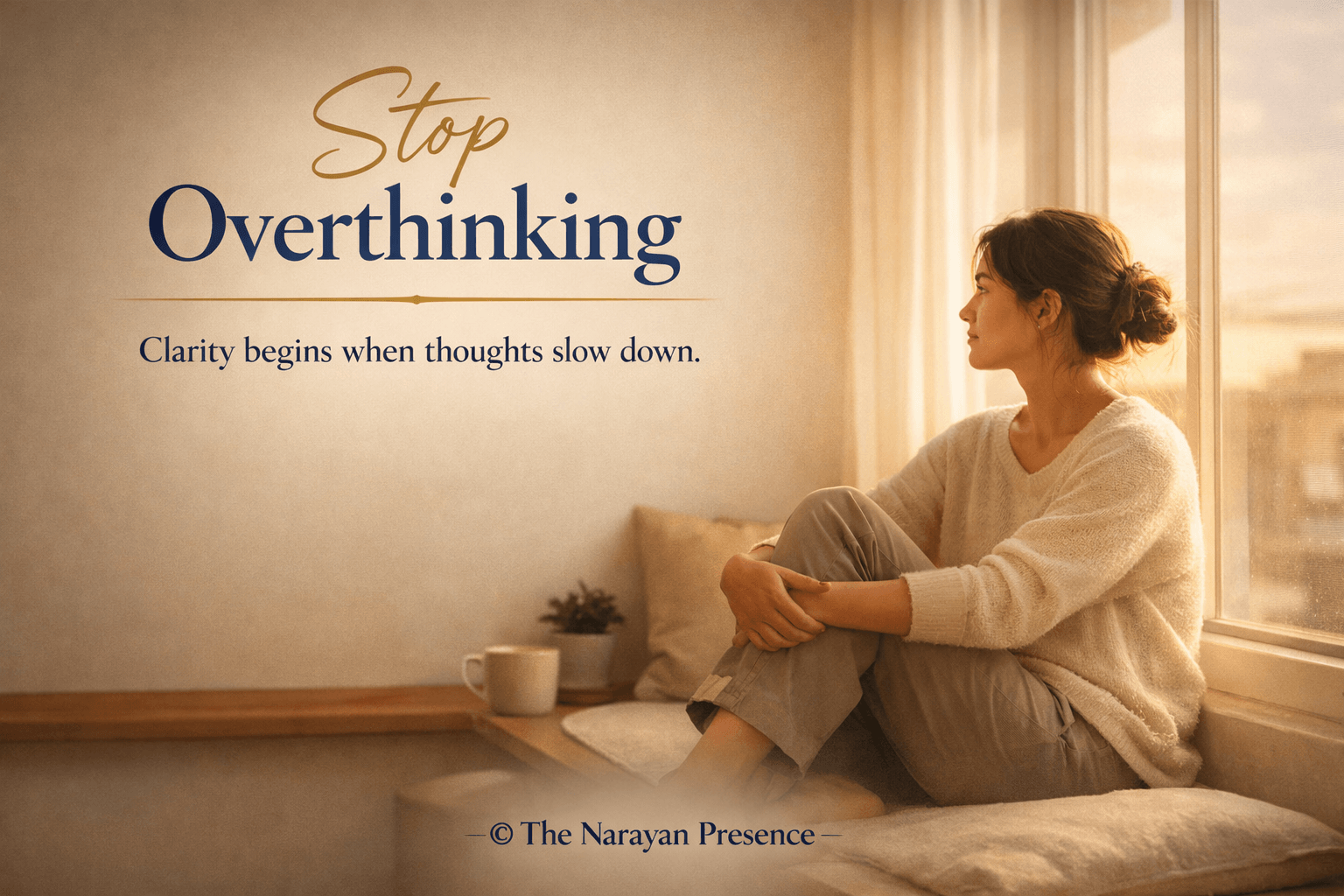
Overthinking often begins quietly.
One thought leads to another.
A small concern turns into multiple scenarios.
And before you realize it, your mind feels crowded and restless.
You replay conversations.
You imagine outcomes.
You question your decisions again and again.
If this feels familiar, you are not alone.
Overthinking is not a flaw.
It is often a sign of a mind trying to protect you.
But when it becomes constant, it can create stress, confusion, and emotional exhaustion.
The goal is not to stop thinking completely.
The goal is to create space between your thoughts.
How to stop overthinking
To stop overthinking:
- Pause and become aware of your thoughts
- Focus on slow breathing to calm the mind
- Write down repetitive thoughts
- Shift attention to the present moment
- Take one small action instead of overanalyzing
With regular practice, overthinking reduces and mental clarity improves.
Why Do We Overthink?
Overthinking usually comes from:
- fear of making mistakes
- uncertainty about outcomes
- desire to control situations
- emotional stress
Your mind is trying to prepare for every possibility.
But instead of helping, it creates mental overload.
This leads to:
- anxiety
- decision fatigue
- lack of clarity
The Hidden Problem with Overthinking
Overthinking feels like problem-solving.
But most of the time:
👉 it is repetitive thinking, not productive thinking
It does not move you forward.
It keeps you stuck.
Clarity does not come from more thinking.
It comes from calm awareness.
Step 1: Notice When Overthinking Starts
The first step is awareness.
Ask yourself:
👉 Am I solving something, or just repeating thoughts?
This simple question creates distance between you and your thoughts.
Step 2: Slow Down Your Mind with Breathing
Your breath is the fastest way to calm mental activity.
Try this:
- inhale for 4 seconds
- exhale for 6 seconds
Repeat for 2–3 minutes.
This helps:
✔ reduce anxiety
✔ slow thought patterns
✔ restore calm
Step 3: Write Your Thoughts Down
Overthinking grows stronger inside your mind.
When you write it down:
- thoughts become clearer
- patterns become visible
- emotional pressure reduces
Write freely.
No structure needed.
Step 4: Shift to the Present Moment
Overthinking lives in:
- past regrets
- future worries
Bring your attention to now.
Notice:
- your breath
- your surroundings
- your body
Even 1–2 minutes helps reset your mind.
Step 5: Take One Small Action
Overthinking delays action.
Action reduces overthinking.
Choose one small step:
- send one message
- complete one task
- make one decision
Small actions break the cycle.
Step 6: Accept That Not Everything Can Be Controlled
Many thoughts come from trying to control outcomes.
But life is uncertain.
Ask yourself:
👉 What is in my control right now?
Focus only on that.
Let the rest go.
How to Build Mental Clarity Daily
Clarity is not instant.
It develops through simple habits:
- daily reflection
- mindful breathing
- gratitude awareness
These practices help you:
✔ understand your thoughts
✔ reduce mental noise
✔ respond calmly
A Simple Reminder
You don’t need to:
❌ think about everything
❌ solve everything today
You only need:
✔ one clear thought
✔ one calm moment
✔ one small step
Conclusion
Overthinking is not your enemy.
It is a signal.
A signal that your mind needs rest, clarity, and space.
When you slow down, observe your thoughts, and take small actions, clarity begins to return.
Not all at once.
But gradually.
And that is enough.
If you often feel stuck in overthinking, guided reflection can help you understand your thoughts more clearly.
At The Narayan Presence, we offer simple reflection sessions to support emotional clarity, mindful awareness, and balanced thinking.
👉 Explore reflection sessions!
FAQs
How do I stop overthinking quickly?
Pause, take slow breaths, and focus on one small action. This helps reduce mental overload and restore clarity.
Why do I overthink everything?
Overthinking often comes from fear, uncertainty, or the need to control outcomes. It is a natural response but can be managed with awareness.
Can overthinking cause anxiety?
Yes, constant overthinking can increase anxiety and mental stress by creating repetitive thought patterns.
What is the best way to clear your mind?
Mindful breathing, writing thoughts down, and focusing on the present moment are effective ways to clear your mind.